Great job. You have now practiced the essential conversations for travelling by air.
Answering questions at customs.
Requesting help for flight attendants.
Reporting missing luggage.
Asking for direction.
Exchanging money or buy a sim card.
Key Prhases you learned in this Unit.
May i see your passport and custom form?
Could i have some water please’
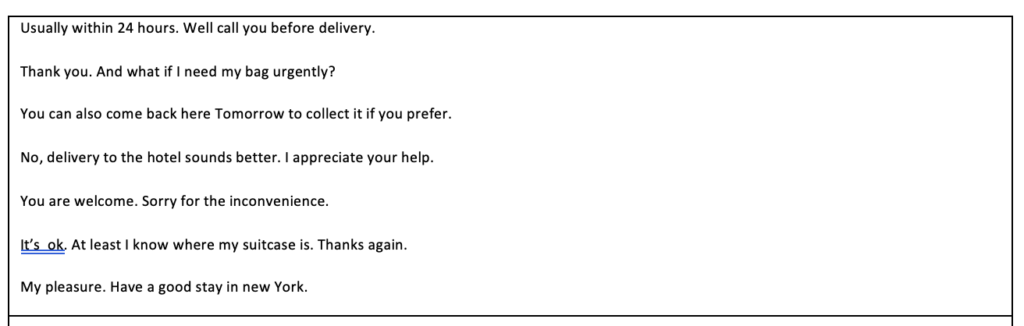
My suitcase isn’t arrived.
Excuse me could you tell me where….?
What’s the Exchange rate?
Keep practicing these phrases aloud until they feel natural.
The more you repeat more confident you’ll sound on your next trip.
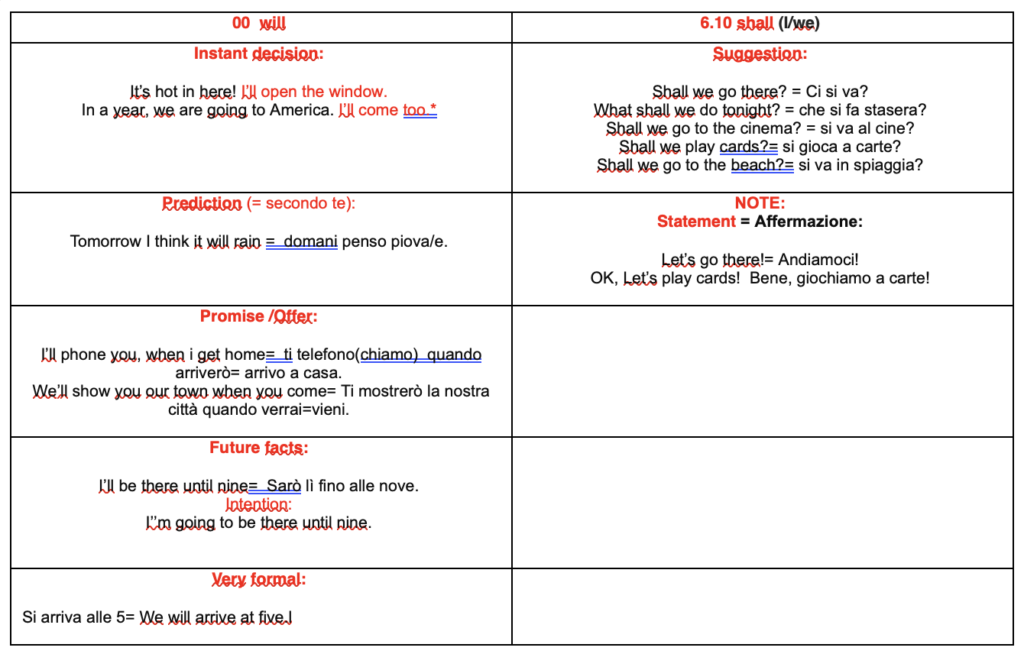
Shall:
Quando si usano Will e Shall?? Qual è la differenza??————–(8.37)
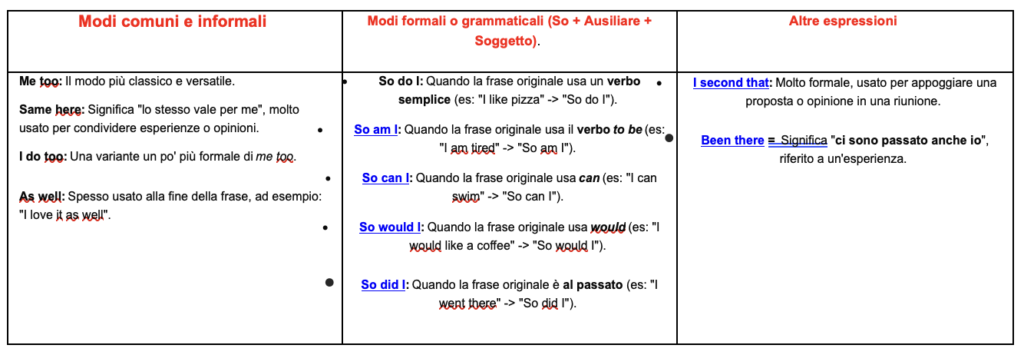
*Note: ———————-“anche io”
In inglese, il modo più comune e informale per dire “anche io” è “Me too”. Tuttavia, esistono diverse alternative più raffinate o specifiche a seconda del contesto, come “So do I“ (per frasi affermative con ausiliari) o “Same here“ (per concordare su un’esperienza o sentimento). Ecco i principali modi per dire “anche io” in inglese:
Nota Bene:
Se la frase originale è negativa (“Non mi piace…”), non si usa me too, ma:
Sir Rod Stewart (born 1945) is a legendary English singer-songwriter known for his raspy voice, spanning rock, folk, and soul
“I am sailing” significa letteralmente “sto navigando” in inglese. È una frase al present continuous che indica un’azione in svolgimento, spesso associata all’andare a vela o, metaforicamente, al muoversi attraverso la vita o le difficoltà..
Rod Stewart – Sailing (Official HD Remastered Video )(4.25)
Rod Stewart – Sailing (from One Night Only! Rod Stewart Live at Royal Albert Hall)(4.56)
Easter Counting Song for Kids | What’s Inside the Golden Egg? (3.46)
The currency Exchange is right over there, next to the ——————————–exit.
Thank you.
WALKS TO COUNTER:
Hello,I’d like to Exchange 300 euros into US dollars please.
Of course sir, the Exchange rate today iso ne euro,to one dollar and five cents.
Are there any——————-?yes, there is a five dollar service fee.
That’s fine please go ahead!
Yes, here you are. 310 US dollars in cash. Please count it.
Perfet thank you.
Hello, I’d like to buy a SIM CARD for my phone.
Sure, we have 7 day plan and 30 day plan. Which one would you like?
The 30 day plan, please. How much data does it include?
It includes with 20 gigabytes of data, unlimited ————–and text within us.
Great,how muchi s it?
$ 35.
Ok, I’ll take it. Can you help me——————-?
Of course. Please give me your phone to install sim. Done. It is ready to use.
Thank you very much.You are welcome. Enjoy your stay.
Solutions
Excuse me where can I Exchange money?
The currency Exchange is right over there, next to the baggage claim exit.
Thank you.
WALKS TO COUNTER:
Hello,I’d like to Exchange 300 euros into US dollars please.
Of course sir, the Exchange rate today iso ne euro,to one dollar and five cents.
Are there any fees? yes, there is a five dollar service fee.
That’s fine please go ahead!
Yes, here you are. 310 US dollars in cash. Please count it.
Perfet thank you.
Hello, I’d like to buy a SIM CARD for my phone.
Sure, we have 7 day plan and 30 day plan. Which one would you like?
The 30 day plan, please. How much data does it include?
It includes with 20 gigabytes of data, unlimited calls and text within us.
Great,how muchi s it?
$ 35.
Ok, I’ll take it. Can you help me install?
Of course. Please give me your phone to install sim. Done. It is ready to use.
Thank you very much.You are welcome.Enjoy your stay.
Key phrases you learned today:
Where can I exchange money?
———————————————————-
——————————————————
………………………………………………………………..
……………………………………………………………………
Solutions:
Where can I Exchange money?
What’s the Exchange rate?
Are there any fees?
I’d like to buy a sim card.
How much data does it include?
Present Perfect:
Il Present Perfect inglese (soggetto + have/has + participio passato) descrive azioni passate con rilevanza presente o non concluse. Spesso si traduce in italiano col passato prossimo (ho mangiato) o il presente (lavoro qui da…), evidenziando il legame con l’oggi (es: I’ve lost my keys = ho perso le chiavi).
Ecco una lista di frasi comuni con il Present Perfect e la loro traduzione in italiano, divise per utilizzo:
Esperienze ed Eventi (Life Experiences)
I have been to Rome this week. - Sono stato a Roma questa settimana.
Have you ever lost your mobile phone? - Hai mai perso il tuo cellulare?.
I have never seen such a beautiful sunset. - Non ho mai visto un tramonto così bello.
She has met the President. - Lei ha incontrato il Presidente.
Azioni Recenti (Recent Actions – “Just”)
I’ve just made a sandwich. - Ho appena preparato un panino.
They have already finished their homework. - Hanno già finito i compiti.
Wait, I’ve forgotten to turn off the lights. - Aspetta, ho dimenticato di spegnere le luci.
He has just gone out. - È appena uscito.
Azioni che continuano (For/Since)
I have lived here for five years. - Vivo qui da cinque anni.
She has worked here since 2010. - Lavora qui dal 2010.
We haven’t seen each other for ages. - Non ci vediamo da una vita.
Azioni non concluse (Yet/Not yet=ancora)
He hasn’t done his homework yet. - Ancora non ha fatto i compiti.
They haven’t delivered the documents yet. - Non hanno ancora consegnato i documenti.
Struttura Present Perfect vs Italiano
Inglese (Present Perfect)
Italiano (Passato Prossimo/Pres.)
I have lost my keys.
Ho perso le chiavi.
She has broken the vase.
Ha rotto il vaso.
We have bought a new car.
Abbiamo comprato una macchina nuova.
They have decided to leave.
Hanno deciso di partire.
Nota:
A differenza dell’italiano che usa sia “essere” che “avere” come ausiliari
l’inglese usa solo “have/has”
EG: (I have gone= sono andato /I have eaten= ho mangiato).
Vorrei proporre un brindisi agli sposi= I would like to suggest a TOAST to the bride and groom.
Let’s toast the president= facciamo un brindisi al presidente. Shall we toast before we drink? = Facciamo un brindisi prima di bere?
If you scrach my car, you are toast! = Se mi graffi la macchina sei morto!
Dialogue Four:
Asking for directions inside the airport.
Fill in the blanks with the right word:
on your right
far
what about
straight ahead
turn left
safe
food court= area dedicata alla ristorazione
restroom
Excuse me, could you tell me where Gate C 12 is?
Of course, just follow the signs ahead, then ———— at the———————————.
Thank you. Is it ————from here?
Not too far, about a five minutes walk.
Perfect. And where is the——————- please?
The resroom is just before Gate 12—————————–.
Great. And ————————restaurants?
There is a café and a fast food area near the Gate.
That’s sound good I may stop there. Oh one more thing. Where can I find the information desk?
The information desk is right in the center Hall. If you walk——————————, You’ll see it next to the elevators.
Thank you so much for your help.You are welcome.Have a ————flight.
Thanks bye.
Solutions.
Excuse me, could you tell me where Gate C 12 is’
Of course, just follow the signs ahead, then turn left at the food court.
Thank you. Is it far from here?
Not too far, about a five minutes walk
Perfect. And where is the restroom please?
The resroom is just before Gate 12 on your right.
Great. And what about restaurants?
There is a café and a fast food area near the Gate.
That’s sound good I may stop there. Oh one more thing. Where can I find the information desk?
The information desk is right in the center Hall. If you walk straight ahead, You’ll see it next to the elevators.
Thank you so much for your help.You are welcome.Have a safe flight.
Thanks bye.
Key phrases you learned today:
Excuse me, could you tell me where…?
………………………………………………….
………………………………………………….
……………………………………….
……………………….……………./…………………………………………
Solutions:
Excuse me, could you tell me where…?
Is it far from here?
Just follow the signs.
Straight ahead.
On your right/on your left.
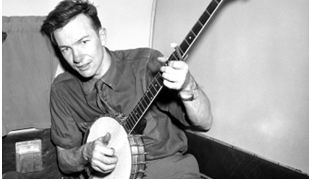
Peter ” Pete ” Seeger
(May 3, 1919 - January 27, 2014) was an American folk singer and left wing social activist.
Pete Seeger, We Shall Overcome (Version #02), Berlin, DDR (GDR), 1967 (3.42)
Bob Dylan & Joan Baez: When a Love Story Became a Movement (1.32)
“Where Have All the Flowers Gone?” is a folk song written by American singer-songwriter Pete Seeger in 1955.
Inspired lyrically by the traditional Cossack folk song “Koloda-Duda”, Seeger borrowed an Irish melody for the music.
This song stands as a protest against meaningless death, inhuman war, and the disregard for life that many seem to carry
“Where Have All the Flowers Gone?” è una canzone folk scritta dal cantautore americano Pete Seeger nel 1955
. Ispirato liricamente dalla tradizionale canzone popolare cosacca “Koloda-Duda”, Seeger ha preso in prestito una melodia irlandese per la musica.
Questa canzone rappresenta una protesta contro la morte senza senso, la guerra disumana e il disprezzo per la vita che molti sembrano portare.
Cossack folk song “Koloda-Duda”,
“Where Have All the Flowers Gone?” is a folk protest song written by American musician Pete Seeger in 1955, with its melody derived from the traditional Ukrainian Cossack lullaby “Koloda-duda” and the initial three verses addressing the transformation of flowers into young girls, then soldiers in a cycle of war’s deva station.
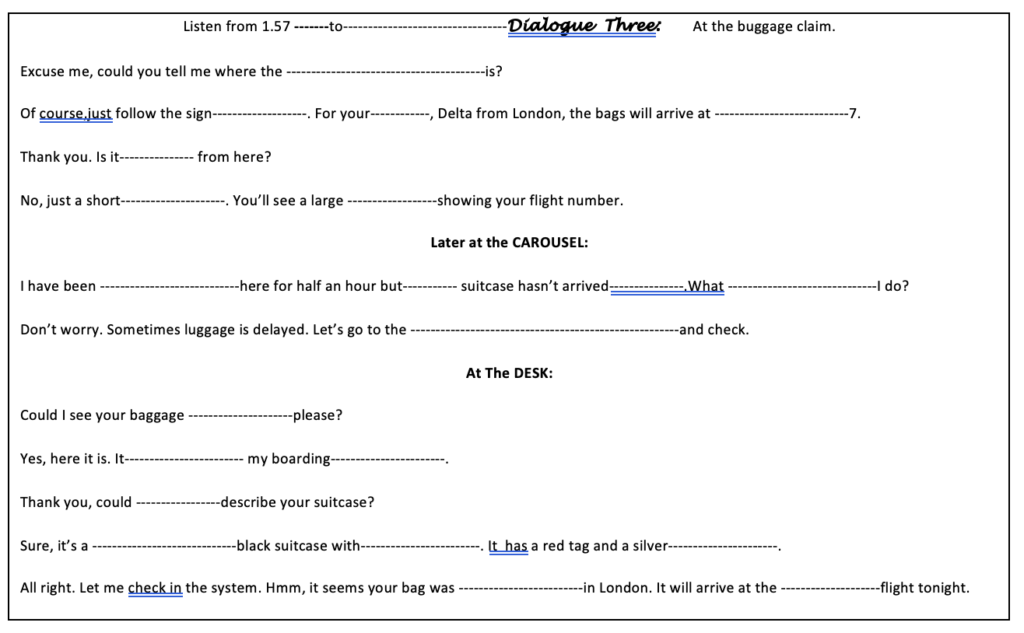
Baggage claim refers to the area within an airport where passengers retrieve(= recuperano) their checked luggage after a flight.
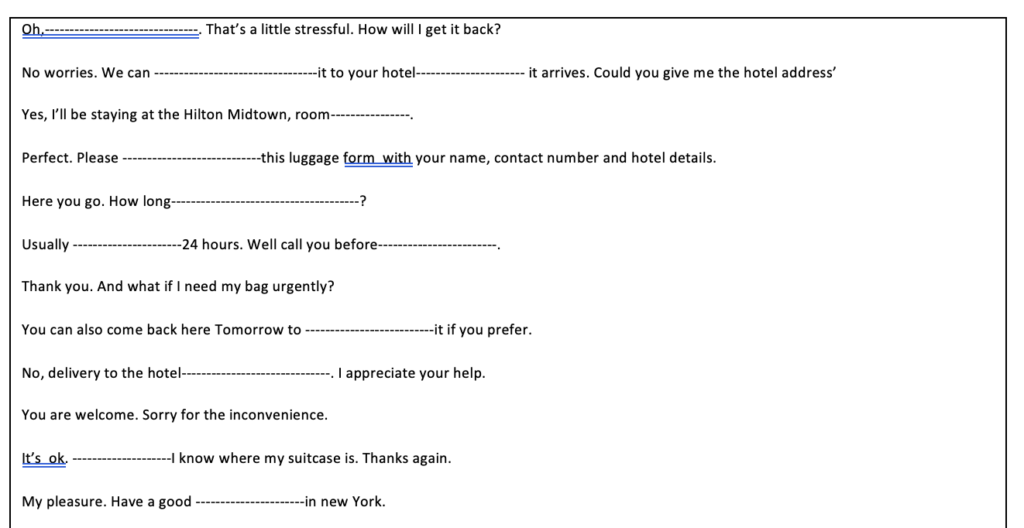
Fill in the blanks with the right word:
Key phrases you learned today:–Where is the baggage claim area?—————
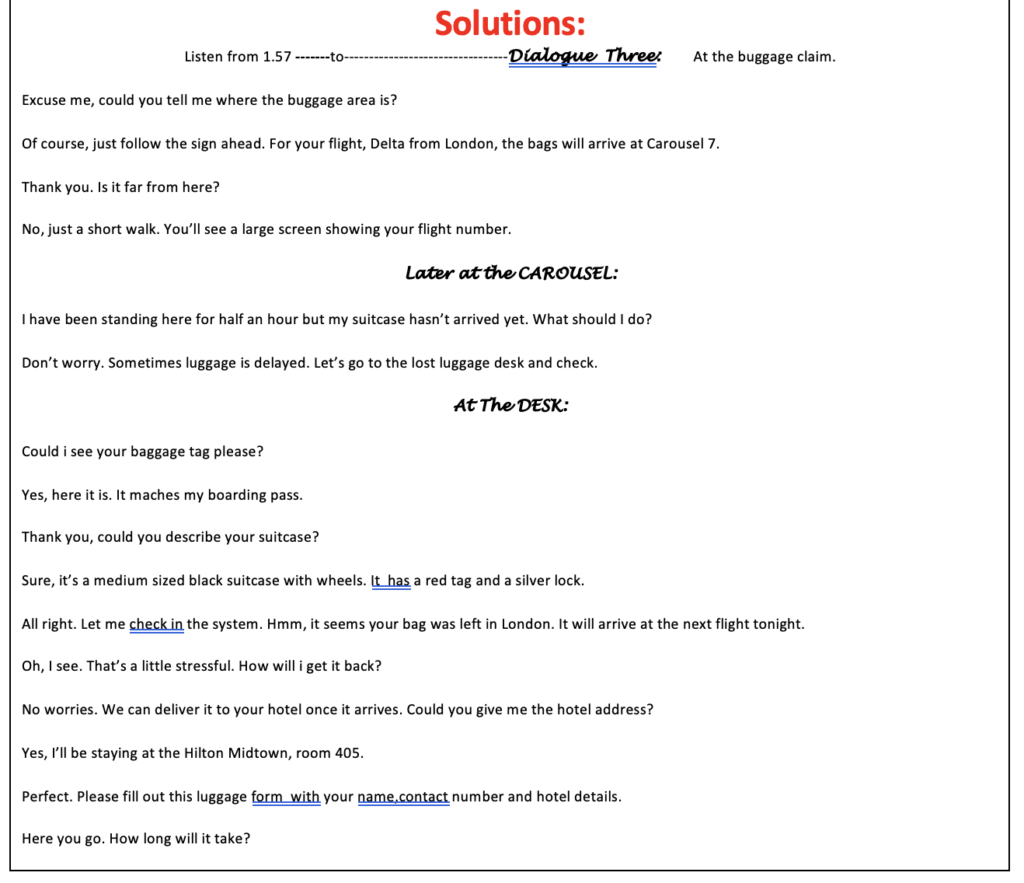
Solutions: Where is the baggage claim area? My suitcase hasn’t arrived. Could You describe your suit case? It’s a black suitcase with a red tag. Please, fill out this luggage form. We’ll deliver it to your hotel.